Search This Blog

Showing posts with label Peach Trees Camping Area. Show all posts

Saturday, October 21, 2017

Walks and Wildlife at Peach Trees Camping Area, Jimna State Forest, QLD.

Three walks leave from Peach Trees Camping Area. 

Yabba Creek Circuit, 730 m, grade 2 walk:
This is a popular walk with families and nature lovers. As we made our way towards the suspension bridge on the Yabba Creek Circuit, a man carrying a camera with a very large lens overtook us and raced to get to the walk first. He told us that he was intent on getting a photo of an Eastern Whipbird and apparently he didn't want us ahead of him disturbing the birds! After a while he stopped on the path and was intently taking photos so we stopped a few meters back and waited for him to achieve his goal. While waiting, I spotted a male Regent Bowerbird and we managed to get some photos. 


Regent Bowerbird, male.

After a while, the birder came back to us and told us that he had been taking close up photos of an Eastern Yellow Robin sitting on it's nest. We were horrified because birds are easily stressed and have been known to abandon their nests if they feel uncomfortable. Of course we have learnt these things over time. If you are interested in learning more, Birdlife Australia has published an Ethical Birding Guidelines PDF that is helpful. It turns out that the birder didn't manage to get a photo of an Eastern Whipbird. After the incredulous look he gave us when we told him we had been taking photos of a Regent Bowerbird we didn't have the heart to tell him that we had in fact managed to get a couple of photos of an Eastern Whipbird as well.


Not the greatest photo of an Eastern Whipbird but relevant to the story.

We often encounter goannas sunning themselves on the path.

Lace Monitor (goanna)
Turtles and Little Pied Cormorant on Yabba Creek.
We have, in the past, viewed platypus in Yabba Creek from different places on the path. We didn't miss out altogether on this trip though because we saw them while walking the Eugenia Circuit.

Araucaria Circuit, 3.5 km, grade 3 walk.
An extension of the Yabba Creek Circuit which I have written about previously.

Eugenia Circuit, 2.4 km, grade 3 walk.
The first part of this walk climbs gradually to a lookout before descending again to the creek. The second half of the walk is mostly flat. We have walked this circuit many times over the years and there is always something interesting to see. This time, the highlight was seeing several active platypus moving about Yabba Creek.


I certainly wish I had the eyesight of this Grey Goshawk when viewing wildlife.

Grey Goshawk
I attached a full list of wildlife that we saw on this visit to the blog Peach Trees Camping Area.

Thursday, October 19, 2017

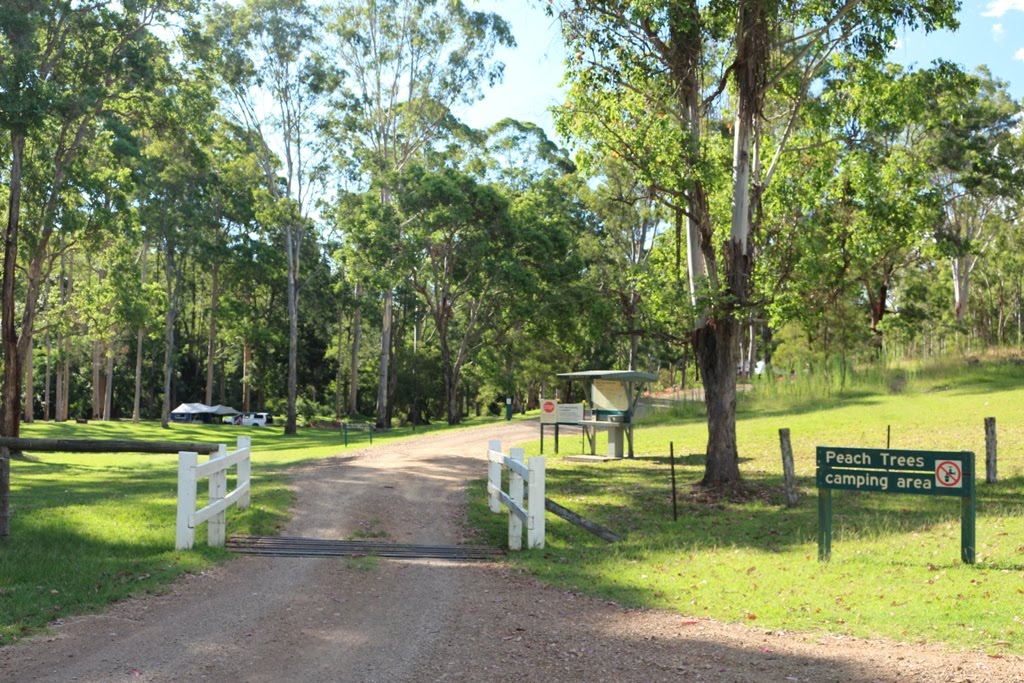
Peach Trees Camping Area, Jimna State Forest, QLD.

Peach Trees Camping Area is a large grassy campground frequented by Eastern Grey Kangaroos.


Peach Trees Camping ARea
Eastern Grey Kangaroos relax around the campground.
Blue-faced Honeyeaters turn up quickly when they notice you preparing food. They can get quite vocal as they beg for food but it is best to ignore them. We went for a walk in the early evening and saw lots of bandicoots and pademelons near the creek.


Juvenile Blue-faced Honeyeater on the lookout for food.
Over the years we have seen quite a few changes at Peach Trees. The latest addition is a specifically designed wheelchair access campsite near the far amenities block.


Wheelchair Access Disability Campsite.
I have often wondered why the campground was named "Peach Trees". On this trip we saw several trees in blossom so I guess that explains it.


Peach Tree blossoms?

Entry to the suspension bridge over Yabba Creek at Peach Trees Camping Area.

Details for Peach Trees Camping Area, Jimna, QLD:
Where: about 142 km north-west of Brisbane. About 43 km north of Kilcoy. The directions on Google Maps are incorrect. From Kilcoy-Murgon Road take the sign posted turnoff between School Road and the Jimna Fire Tower.
Access: The last 3 km is unsealed. There is a concrete causeway, just before the campground, that can flood in wet weather.
Campground: Large grassy area suitable for tent camping beside your vehicle and all rigs. 1 designated wheelchair accessible campsite.
Bookings and Fees: National Parks Queensland provides limited WiFi at the campground which can be used to make bookings and to check the weather etc. It would be best to pre-book at busy times. Book online https://qpws.usedirect.com/qpws/ or by phone 13 74 68  Standard National Parks QLD fees. We paid $6.30 pp.
Facilities: There are three amenities blocks with flush toilets. Taps with non-potable water throughout the campground. Fire rings (BYO wood). Walks. QldParks-Wifi. We did not have Telstra phone reception. We have heard that there is some Optus reception but can't confirm. The Day Use Area has been removed and there are no longer any tables in the campground (with the exception of one disability access table which is in the designated wheelchair access campsite). 
Prohibitions: No pets. No generators.

Wildlife List:
Lace Monitors, Eastern Grey Kangaroos, Pademelons, Bandicoots, Antechinus, Freshwater Turtles, Platypus, Micro Bats. 
Butterflies: Scarlet Jezebel, Glasswing, Monarch, Orchard Swallowtail.
Bird List: Grey Goshawk, Satin Bowerbird, Regent Bowerbird, Australian Brush Turkey, Yellow-tailed Black Cockatoo, Sulphur-crested Cockatoo, Little Pied Cormorant, Black-faced Cuckoo-shrike, Pied Currawong, Torresian Crow, Australian Wood Duck, Brown Cuckoo-Dove, Superb Fairy-wren, Grey Fantail, Rufous Fantail, Red-browed Finch, Noisy Friarbird, White-necked Heron, Blue-faced Honeyeater, Lewin's Honeyeater, New Holland Honeyeater, Laughing Kookaburra, Rainbow Lorikeet, Australian Magpie, Magpie-lark, Bell Miner, Noisy Miner, Australian King Parrot, Paradise Riflebird, Eastern-Yellow Robin, Pale-headed Rosella, White-browed Scrubwren, Little Shrike-thrush, Grey Shrike-thrush, Welcome Swallow, Brown Thornbill, Russet-tailed Thrush, Varied Triller, White-throated Treecreeper, Brown Quail, Eastern Whipbird, Golden Mangrove, Willie Wagtail, Dusky Woodswallow. Heard: Green Catbird, Southern Boobook, Tawny Frogmouth.

Saturday, January 23, 2016

Peach Trees Camping Area, Jimna State Forest, QLD.


Peach Trees Camping Area.
Peach Trees is 43 km north of Kilcoy on a sealed road with the last 3 km a good unsealed section into the campground. The first thing you notice about Peach Trees is the number of kangaroos lazing about the grassy camping area. Pets are not permitted. There are four new amenities blocks with flushing toilets but no showers. Non-potable water taps and fire pits are scattered throughout the camp ground and there are also a few tables and wood-fired BBQ’s. There is Optus phone reception but no Telstra reception. Standard QLD National Park fees apply. Either pre-book before arriving or there is a public pay phone near the first amenities block. I must admit that I stood in front of the pay phone and realized that I have no idea how to use a pay phone or what coins it takes!

Pay Phone at Peach Trees Camping Area
The Day Use Area is a cordoned off section within the campground which has tables and BBQ’s.

Peach Trees Day Use Area.
We took care to set up in an area with good shade as the temperature was predicted to reach 36 C while we were there. We saw more birds in the first two hours at Peach Trees than we had for our whole stay at Benarkin State Forest. Our site overlooked the path on the other side of Yabba Creek and we were pleasantly surprised to see Yellow-tailed Black Cockatoos, Satin Bowerbirds and Bell Miners from our camp. Large numbers of Sulphur Crested Cockatoos were flying overhead.

Yellow-tailed Black Cockatoos
Bell Miner
There were less butterflies here than at Benarkin but they were mostly the same types: Wanderer, Lesser Wanderer, Glasswing, Common Crow, Evening Brown and Orchard Swallowtail.

Wanderer Danaus plexippus
There are three walking tracks leaving from the campground: Yabba Creek Circuit, Araucaria Circuit and Eugenia Circuit. We also liked to walk to the causeway just before the entrance to the camp ground. The first morning we walked them all in one continuous circuit and on the following days we just redid our favourite parts.

Causeway: The causeway proved a great spot to check out in the early morning or late afternoon. We regularly saw both Azure and Sacred Kingfishers fishing above the creek and there were lots of juvenile Eastern Water Dragons sunning themselves at the waters edge. We saw many small birds in the brush near the causeway.


Azure Kingfishers at the causeway.
Eugenia Circuit is a 2.5 km, Class 4 walk.
Starting near the entry to the camp ground this walk climbs steadily up a shale track to a lookout above Yabba Creek before descending again. The track crosses the creek, which was completely dry at this point, and returns alongside the creek before emerging on the other side of the causeway at the entrance to the campground. 

One of the many Sulphur-crested Cockatoos seen on the walk.
Red-browed Finch
We remember doing this walk after heavy flooding the last time we were here and there are still giant piles of debris perched high above the creek standing testimony to the awesome power of flooding.

Raft of debris left high above Yabba Creek.
The second time we did this walk we were thrilled to see the golden flash of a male Regent Bowerbird flying past us three times. We back tracked a bit and found him and a female sitting in a tree. On our way out the path was blocked by a Red-bellied Black but it quickly departed when it decided that staying still wasn't going to make us go away.

Red-bellied Black Snake.
Yabba Creek Circuit is a 700m, Class 3 walk. 
Yabba Creek Circuit is a pleasant easy walk with the added bonus of a small swing bridge at one end and a walk bridge at the other end. There are plenty of birds on the walk and we saw kangaroos using the path. We walked this circuit several times at different times of the day during our stay.

Swinging Bridge over Yabba Creek
Foot bridge over Yabba Creek
This very young Brush Turkey was seeking shelter up a tree which is typical behaviour for Brush Turkeys every evening. We also saw a Wonga Pigeon up a tree whereas previously we have always seen them on the ground.
Juvenile Australian Brush Turkey and Wonga Pigeon.
Black-faced Monarchs, Eastern Spinebills and Brown Cuckoo-Doves were easy to spot on the trail.

Black-faced Monarch
Brown Cuckoo-Doves
Araucaria Circuit is a 4.5 km, Class 3 walk.
This walk starts just over the swing bridge. At first it climbs through a dry eucalypt forest before entering a cool vine forest of young Hoop and Bunya Pine then returning via the eucalypt forest again.

Araucaria Circuit
Scarlet Honeyeater on the Araucaria Circuit
When we left Peachtrees Camping Area we stopped at the Jimna Fire tower for a quick look. 

Jimna Fire Tower

Bird List: 
Australian Brush Turkey, Australian Wood Duck, Nankeen Night Heron, Topknot Pigeon, Brown Cuckoo-Dove, Wonga Pigeon, Yellow-tailed Black Cockatoo, Sulphur-crested Cockatoo, Rainbow Lorikeet, Australian King Parrot, Pale-headed Rosella, Fan-tailed Cuckoo, Pheasant Coucal, Tawny Frogmouth, Dollarbird, Azure Kingfisher, Sacred Kingfisher, Laughing Kookaburra, White-throated Treecreeper, Variegated Fairy-wren, White-browed Scrubwren, Yellow-throated Scrubwren, Brown Gerygone, Brown Thornbill, Noisy Friarbird, Blue-faced Honeyeater, Bell Miner, Noisy Miner, Lewin's Honeyeater, White-naped Honeyeater, New Holland Honeyeater, Eastern Spinebill, Scarlet Honeyeater, Eastern Whipbird, Eastern Yellow Robin, Grey Shrike-thrush, Golden Whistler, Grey Fantail, Rufous Fantail, Willie Wagtail, Leaden Flycatcher, Black-faced Monarch, Magpie-lark, Spangled Drongo, Olive-backed oriole, Australasian Figbird, Satin Bowerbird, Regent Bowerbird, Varied Triller, Grey Butcherbird, Australian Magpie, Pied Currawong, Torresian Crow, Welcome Swallow, Red-browed Finch, Silvereye, Bassian Thrush.