|
| Sundown National Park |
Sundown National Park is an outstanding birdwatching area offering good opportunities to see Turquoise Parrots. A 4WD is not necessary to enter the south-western section of Sundown National Park, however, parts of the road to The Broadwater Camping Area are narrow and not suitable for long or wide vehicles.
 |
| Entry to the south-western section of Sundown National Park. |
 |
| Road to The Broadwater Camping Area. |
Take a container and collect some water at the Park Headquarters which is 1 km before the campground.
 |
| Water station on the way to The Broadwater Camping Area. |
As an added bonus, we saw some nice birds as we filled up our water container.
 |
| Diamond Firetail |
 |
| Yellow-rumped Thornbill |
The main area of the campground has a row of sites quite close together. Each site is defined with wooden barriers that could make it hard to manoeuvre a long vehicle.
 |
| The Broadwater Campground |
You can no longer self-register at The Broadwater Camping Area and it is necessary to choose a site number when booking; always a challenge if you haven't seen the sites.
 |
| Site 10 showing the wooden barriers enclosing the campsites. |
Sites 13 to 16 are grassy open areas listed as group camping sites.
 |
| Jacky Winter at Site 15. |
Amenities at the campground include non-flush toilets and a donkey shower . Wood is not provided.
 |
| Donkey Shower and Shower Cubicles. |
Eastern Grey Kangaroos graze around the campground in the late afternoon.
 |
| Eastern Grey Kangaroos watching me watching them. |
In the early evening we could see Nightjars chasing micro-bats. As the campground is reasonably remote, the stars were particularly bright at night.
Details for The Broadwater Camping Area:
Where: In the south-western section of Sundown National Park. 300 km south-west of Brisbane. Turn off Glenlyon Dam Road into Permanents Road and follow the road for 4 km until arriving at the campground.
Access: 2WD access. 4 km narrow unsealed road. National Parks QLD state that "caravans longer than 4 meters are not recommended due to narrow sections along the campground access track." also "Access not suitable for vehicles over 5 tonne."
Fees & Booking: All sites must be booked online or by phone. You used to be able to self-register sites 8 - 15 but this is no longer the case despite outdated information on the internet and on signs near the park headquarters. Maximum length of stay 29 days.
Sites: 15 numbered sites. Sites listed as suitable for tent camping beside vehicle, caravans less than 4 meters, small motorhomes, camper trailers and large groups. Sites 1 - 12 are individual sites defined by barriers. Note that the entrance width to these sites varies from 4 to 7 meters and may be difficult to access in long/wide rigs. Sites 13 - 15 are open grassy areas for large groups and are a long way from the amenities.
Facilities: Non-flush toilets, fire pits, donkey shower with shower cubicle, BYO wood. We had 1 bar Telstra phone reception. There is drinking and non-drinking water available at the park headquarters 1 km before the campground. BYO water container.
Prohibitions: No generators. No pets. Do not collect wood from the bush. Do not dump ashes in the park.
Caution: Ticks.
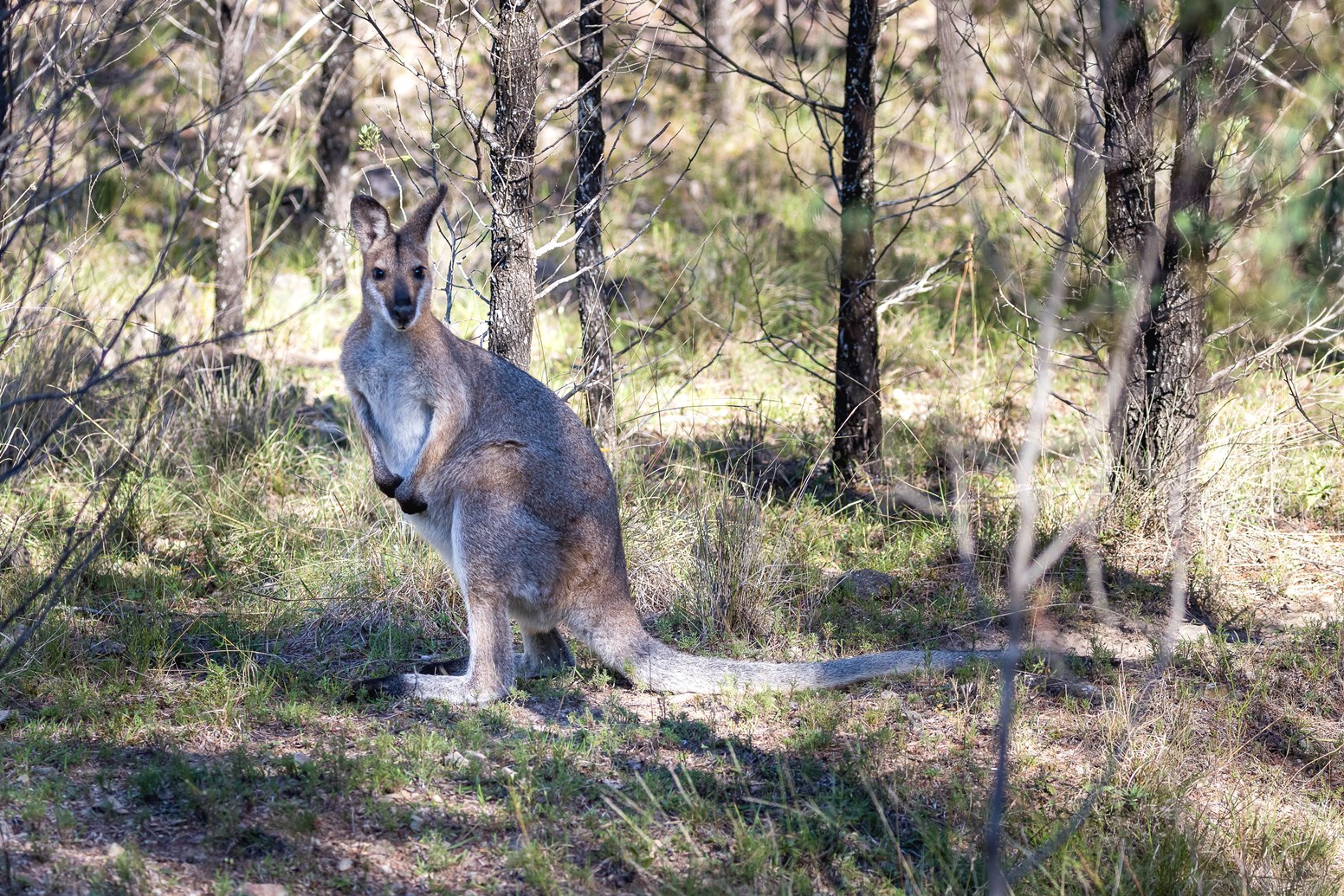
Wildlife List: Eastern Grey Kangaroo, Red-necked Wallaby, Feral Goat, Lace Monitor, Copper-tailed Skink, Eastern Water Dragon, Micro Bats (type unknown). Joseph Coat Moth. Butterflies: Common Brown, Common Crow, Common Grass-blue, Common Plane, Monarch, Orchard Swallowtail.
Birds: Apostlebird, Grey-crowned Babbler, White-browed Babbler, Whistling Kite, Pacific Bazza, Grey Butcherbird, White-winged Chough, Little Corella, Pallid Cuckoo, White-bellied Cuckoo-shrike, Torresian Crow, Pied Currawong, Pacific Black Duck, Bar-shouldered Dove, Spangled Drongo, Superb Fairy-wren, Grey Fantail, Diamond Firetail, Restless Flycatcher, Little Friarbird, White-faced Heron, Striped Honeyeater, Blue-faced Honeyeater, Yellow-faced Honeyeater, White-plumed Honeyeater, Jacky Winter, Common Koel, Laughing Kookaburra, Australian Magpie, Magpie-lark, Noisy Miner, Mistletoebird, Nightjar (unsure of type), Olive-backed Oriole, Australian King Parrot, Red-rumped Parrot, Pheasant Coucal, Red-capped Robin, Eastern Yellow Robin, Eastern Rosella, Pale-headed Rosella, Hybrid: Eastern Rosella x Pale-headed Rosella, White-browed Scrubwren, Silvereye, Welcome Swallow, Yellow-rumped Thornbill, Brown Treecreeper, White-throated Treecreeper, Golden Whistler, Rufous Whistler, Willie Wagtail.