Search This Blog

Monday, April 23, 2018

Kookabitta Campground, Kwiambal National Park, NSW.

Kookabitta Campground looking towards the new camp kitchen shelter.
There are two campgrounds at Kwiambal National Park. Our understanding was that Kookabitta Campground was closed for refurbishment so we drove straight to Lemon Tree Flat Campground and set up. Later, we realised that Kookabitta Campground was open so we went in and had a look. The new kitchen shelter is excellent and overlooks the campground through to the Severn River.

Kookabitta Campground looking towards the Severn River.
There are tables throughout the campground and the fire pits are a bit different as they are concreted holes in the paved platforms.

National Parks New South Wales often supply great camp cooking facilities.
We had heard that Emus come down to the opposite riverbank to drink so we kept an eye open for them. We didn't see any there but overall we saw four in Kwiambal National Park. We did see goats come down for a drink and some Peaceful Doves foraging along the river stones.

Goat coming down for a drink in the Severn River.
Peaceful Doves
In the campground, Brown Treecreepers and White-plumed Honeyeaters were quite active and inquisitive. There were lots of Superb Fairy-wrens and Sulphur-crested Cockatoos are common throughout Kwiambal National Park.

White-plumed Honeyeater
Brown Treecreeper
Sulphur-crested Cockatoo
Superb Fairy-wren; male in eclipse.
Eastern Grey Kangaroos were peacefully grazing in the campground.

Eastern Grey Kangaroo
After walking around the campground we realised that we were covered in grass ticks. We don't know if we came in contact with the ticks at the campground or on the walks we had done that morning. Grass ticks are very small and typically there are lots of them. We do carry a fully stocked first aid kit with us on our travels so we were able to get rid of them but it takes up a bit of time to locate them all.

Details for Lemon Tree Flat Campground:
Where: In Kwiambal National Park. 160 km north-west of Glen Innes via Inverall and Ashford. From Ashford travel along Limestone Road. Turn right into Kookabitta Trail a couple of kilometers before Lemon Tree Flat Campground.
Access: 2WD roads, can become boggy when wet. Approximately 25 km of unsealed roads before arriving at the campground.
Booking & Fees: No bookings, self-register on arrival, $6 per adult, $3.50 per child.
Sites: There is an enclosed grassy area, with separate parking bays, suitable for tent camping. 
There appeared to be only one site at the end of the campground that would be suitable for a motorhome or a camper trailer. The campground is beside the Severn River.
Facilities: Fire places, wood supplied, tables, non-flushing toilets, large camp kitchen shelter with free gas/electric BBQs, rainwater tank (empty when we were there). Fishing is allowed with a permit.
Prohibitions: No noise after 8 pm, no pets, no smoking.
Caution: Grass ticks.
Managed by: National Parks NSW, Tenterfield Office Ph 02 6736 4298


Sunday, April 22, 2018

Lemon Tree Flat Campground, Kwiambal National Park, NSW.

Lemon Tree Flat Campground is in a peaceful setting next to the Severn River. The river is popular for both swimming and fishing.There was a man fishing while we were there and he was apparently catch and releasing one to two Murray Cod a day. A permit is required for fishing in NSW. 

The "Beach" at Lemon Tree Flat Campground.
When we were not out walking and exploring the area we enjoyed watching the wildlife in the campground. Several resident goannas patrol the area; one regular has the Bells Phase variant of skin patterns. 

Bell's Phase Lace Monitor
Eastern Grey Kangaroos graze in the campground alongside Red-necked Wallabies.

Eastern Grey Kangaroos
Red-necked Wallaby with Joey.
Feral goats could also be seen grazing in the quieter areas.

One of many different coloured goats.
Never camp under Gum Trees. There are a number of large Gum Trees along the river bank so we set up further back. While we were there, an area near the information and self-registration shelter had been roped off due to a gum tree dropping a very large limb which was dangling precariously where it was tangled up in other trees. On the bright side, the gum trees attracted Red-winged Parrots and Sulphur-crested Cockatoos.

Red-winged Parrot, male.
Lemon Tree Flat Campground has a a couple of large open grassy areas suitable for driving straight in with a caravan or camper trailer. There is also a large tent camping area surrounded by bollards and there are a number of small parking areas for the tent campers to park their cars next to the bollards. Strangely, when we arrived every car park in the bollarded area was taken up by people with caravans so we ended up putting our tent in an open area so that we could park our ute next to it. 

Lemon Tree Flat Campground
The caravaners appeared to be travelling together and had a sausage sizzle that night. The next day they all left. That afternoon more caravaners arrived and we got a few funny looks from them. They must have been wondering why we were taking up a prime caravan spot instead of setting up in the now empty tent area. Although that situation is a little bit amusing we were not laughing when we went to use the toilet after the first lot of vans had left. Somebody had dumped all their rubbish, including plastic bags and meat trays, down the toilet!


Details for Lemon Tree Flat Campground:
Where: In Kwiambal National Park. 160 km north-west of Glen Innes via Inverall and Ashford. From Ashford travel along Limestone Road. After entering the national park follow signs to the campground.
Access: 2WD roads, can become boggy when wet. Approximately 26 km of unsealed roads before arriving at the campground.
Booking & Fees: No bookings, self-register on arrival, $6 per adult, $3.50 per child.
Sites: Suitable for tents, camping beside vehicle, camper trailer, caravan and motorhome. There are open grassy area suitable for all rig types and an enclosed grassy area, with separate parking, suitable for tent camping. The campground is beside the Severn River, there is access to the river but it is mostly not visible from the campsites.
Facilities: fire places, wood supplied, tables, non-flushing toilets, camp kitchen shelter with free gas/electric BBQ, 1 non-potable water tap near the camp kitchen. Fishing is allowed with a permit. Swimming. Walks. 
Day Use: Share campground facilities. It is best to drive to the end of the campground near the camp shelter. Behind the shelter is access to the river.
Prohibitions: No generators, no pets, no smoking.
Caution: Never camp under Gum Trees.
Managed by: National Parks NSW, Tenterfield Office Ph 02 6736 4298

Wildlife List: Eastern Grey Kangaroo, Red-necked Wallaby, Eastern Wallaroo, Euro, Squirrel Glider, Lace Monitor including Bell's Phase, Eastern Water Dragon, Feral Goats. Butterflies: Common Brown, Lesser Wanderer, Orchard Swallowtail. Birds: Apostlebird, Whistling Kite, White-winged Chough, Sulphur-crested Cockatoo, Galah, Little Pied Cormorant, Fan-tailed Cuckoo, White-bellied Cuckoo-shrike, Pied Currawong, Torresian Crow, Pacific Black Duck, Australian Wood Duck, Peaceful Dove, Bar-shouldered Dove, Spangled Drongo, Emu, Superb Fairy-wren, Grey Fantail, Diamond Firetail, Restless Flycatcher, Noisy Friarbird, White-faced Heron, Spiny-cheeked Honeyeaters, Yellow-faced Honeyeater, White-eared Honeyeater, White-plumed Honeyeater, Sacred Kingfisher, Laughing Kookaburra, Australian Magpie, Magpie-lark, Noisy Miner, Olive-backed Oriole, Red-winged Parrot, Red-rumped Parrot, Crested Pigeon, Common Bronzewing, Eastern Yellow Robin, Pale-headed Rosella, Pale-headed Rosella x  Crimson Rosella, Speckled Warbler, White-browed Scrubwren, Welcome Swallow, Dusky Moorhen, Brown Treecreeper, White-throated Treecreeper, Rufous Whistler, Willie Wagtail.

Thursday, April 19, 2018

Western Circuit Walk and Permanent Waterhole, Sundown National Park, QLD.

Western Circuit Walk, Sundown National Park.
While camping in The Broadwater Camping Area in Sundown National Park we did the short Permanent Waterhole Walk and the Western Circuit Walk. The trail-head for the walks can be found at the far end of the campground where there is an information hut.


Information Hut and walk trail-head at The Broadwater Camping Area.

Permanent Waterhole Walk: Class 3, 2 km return. 
Permanent Waterhole is a popular swimming hole.


Permanent Waterhole
Western Circuit Walk: Class 3, 4.5 km return.
We found this walk to be easy, enjoyable and very exciting for bird-watching. The walk meanders through a forest of cypress pines where we saw many striped honeyeaters foraging in the tree tops.


Cypress Pine Forest
Striped Honeyeater
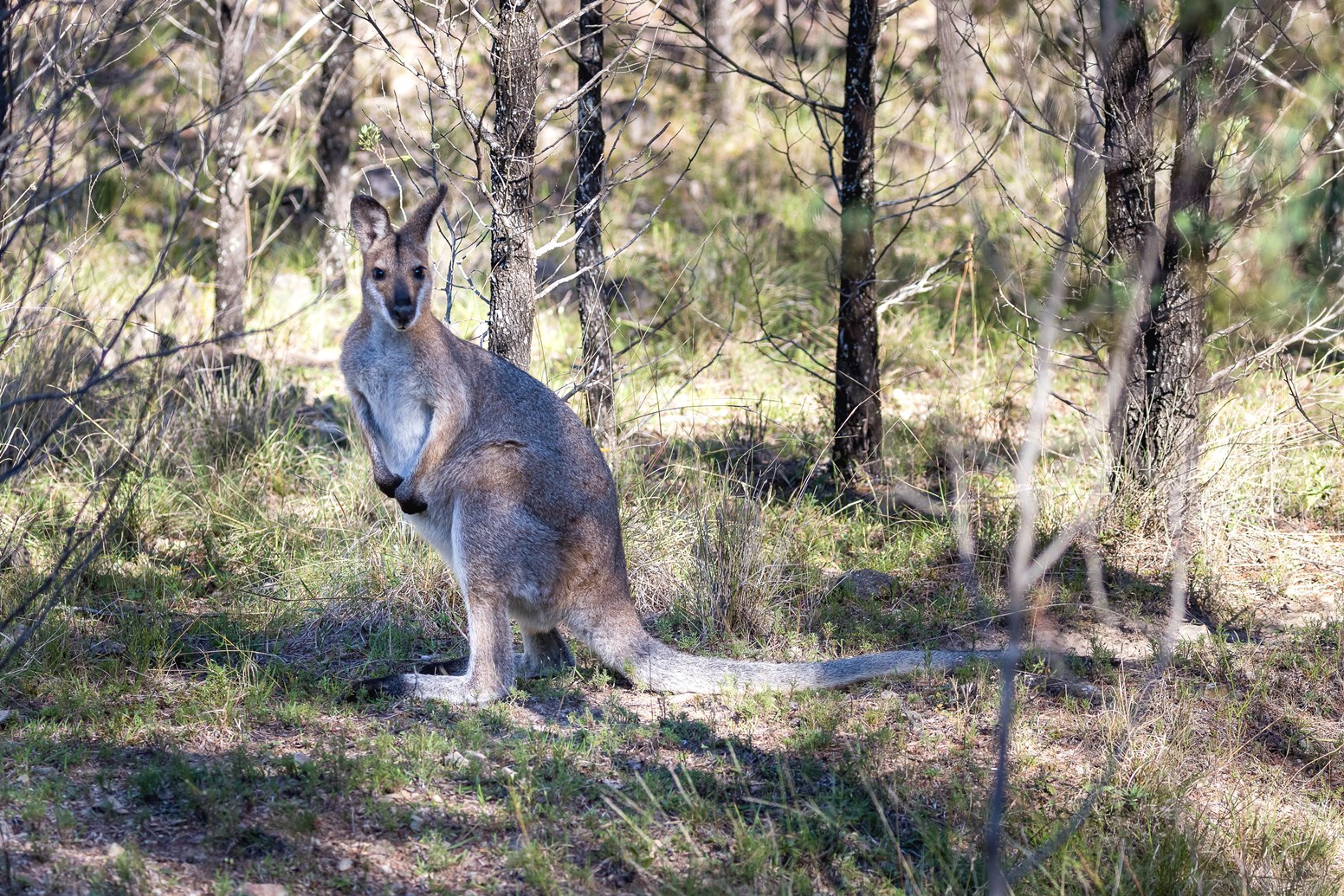
Eastern Grey Kangaroos and Red-necked Wallabies were easy to spot amongst the cedar pines.


Eastern Grey Kangaroo
Red-necked Wallaby.
As we emerged from the cedar pine forest into mixed eucalypt forest there was more variety in the birds we saw. 


Red-capped Robin
Mistletoebird
We were pleased to see White-browed Babblers as well as Grey-crowned Babblers.


White-browed Babbler
Grey-crowned Babblers
We passed a number of large cactus in fruit as we gently climbed to higher open ground. Here we found great views to the south and west over Sundown National Park.


Cactus fruit.
Views over Sundown National Park.
Jackie Winters and White-winged Choughs were present. 


Jacky Winter
Restless Flycatchers, White-plumed Honeyeaters, Golden and Rufous Whistlers all made an appearance,


White-plumed Honeyeater
Golden Whistler
As we descended to the open flats we started to see Red-rumped Parrots, Eastern Rosellas, Pale-headed Rosellas and Barr-shouldered Pigeons. There were also a number of birds about that were hybrid Eastern Rosellas and Pale-headed Rosellas. Every time we saw a turquoise flash we were hopeful of seeing a Turquoise Parrot but all our sightings turned out to be male Red-rumped Parrots.


Entering parrot habitat.
Red-rumped Parrot, male.
Red-rumped Parrot, female.
On the walk we saw one red deer and about twenty goats. National Parks Queensland is closing the park in May 2018 for feral pest eradication so check the Alerts section online before planning a trip to Sundown National Park.

Wildlife List: Eastern Grey Kangaroo, Red-necked Wallaby, Feral Goat, Feral Red Deer, Lace Monitor, Copper-tailed Skink, Eastern Water Dragon, Micro Bats (type unknown). Joseph Coat Moth. Butterflies: Common Brown, Common Crow, Common Grass-blue, Common Plane, Monarch, Orchard Swallowtail. 
Birds: Apostlebird, Grey-crowned Babbler, White-browed Babbler, Whistling Kite, Pacific Bazza, Grey Butcherbird, White-winged Chough, Little Corella, Pallid Cuckoo, White-bellied Cuckoo-shrike, Torresian Crow, Pied Currawong, Pacific Black Duck, Bar-shouldered Dove, Spangled Drongo, Superb Fairy-wren, Grey Fantail, Diamond Firetail, Restless Flycatcher, Little Friarbird, White-faced Heron, Striped Honeyeater, Blue-faced Honeyeater, Yellow-faced Honeyeater, White-plumed Honeyeater, Jacky Winter, Common Koel, Laughing Kookaburra, Australian Magpie, Magpie-lark, Noisy Miner, Mistletoebird, Nightjar (unsure of type), Olive-backed Oriole, Australian King Parrot, Red-rumped Parrot, Pheasant Coucal, Red-capped Robin, Eastern Yellow Robin, Eastern Rosella, Pale-headed Rosella, Hybrid: Eastern Rosella x Pale-headed Rosella, White-browed Scrubwren, Silvereye, Welcome Swallow, Yellow-rumped Thornbill, Brown Treecreeper, White-throated Treecreeper, Golden Whistler, Rufous Whistler, Willie Wagtail.

Tuesday, April 10, 2018

The Broadwater Camping Area, Sundown National Park, QLD.

Sundown National Park
Sundown National Park is an outstanding birdwatching area offering good opportunities to see Turquoise Parrots. A 4WD is not necessary to enter the south-western section of Sundown National Park, however, parts of the road to The Broadwater Camping Area are narrow and not suitable for long or wide vehicles. 

Entry to the south-western section of Sundown National Park.
Road to The Broadwater Camping Area.
Take a container and collect some water at the Park Headquarters which is 1 km before the campground.

Water station on the way to The Broadwater Camping Area.
As an added bonus, we saw some nice birds as we filled up our water container. 

Diamond Firetail
Yellow-rumped Thornbill
The main area of the campground has a row of sites quite close together. Each site is defined with wooden barriers that could make it hard to manoeuvre a long vehicle. 

The Broadwater Campground
You can no longer self-register at The Broadwater Camping Area and it is necessary to choose a site number when booking; always a challenge if you haven't seen the sites. 

Site 10 showing the wooden barriers enclosing the campsites.
Sites 13 to 16 are grassy open areas listed as group camping sites. 

Jacky Winter at Site 15.
Amenities at the campground include non-flush toilets and a donkey shower . Wood is not provided.

Donkey Shower and Shower Cubicles.
Eastern Grey Kangaroos graze around the campground in the late afternoon. 

Eastern Grey Kangaroos watching me watching them.
In the early evening we could see Nightjars chasing micro-bats. As the campground is reasonably remote, the stars were particularly bright at night.


Details for The Broadwater Camping Area:
Where: In the south-western section of Sundown National Park. 300 km south-west of Brisbane. Turn off Glenlyon Dam Road into Permanents Road and follow the road for 4 km until arriving at the campground. 
Access: 2WD access. 4 km narrow unsealed road. National Parks QLD state that "caravans longer than 4 meters are not recommended due to narrow sections along the campground access track." also "Access not suitable for vehicles over 5 tonne." 
Fees & Booking: All sites must be booked online or by phone. You used to be able to self-register sites 8 - 15 but this is no longer the case despite outdated information on the internet and on signs near the park headquarters. Maximum length of stay 29 days.
Sites: 15 numbered sites. Sites listed as suitable for tent camping beside vehicle, caravans less than 4 meters, small motorhomes, camper trailers and large groups. Sites 1 - 12 are individual sites defined by barriers. Note that the entrance width to these sites varies from 4 to 7 meters and may be difficult to access in long/wide rigs. Sites 13 - 15 are open grassy areas for large groups and are a long way from the amenities.
Facilities: Non-flush toilets, fire pits, donkey shower with shower cubicle, BYO wood. We had 1 bar Telstra phone reception. There is drinking and non-drinking water available at the park headquarters 1 km before the campground. BYO water container.
Prohibitions: No generators. No pets. Do not collect wood from the bush. Do not dump ashes in the park.
Caution: Ticks.

Wildlife List: Eastern Grey Kangaroo, Red-necked Wallaby, Feral Goat, Lace Monitor, Copper-tailed Skink, Eastern Water Dragon, Micro Bats (type unknown). Joseph Coat Moth. Butterflies: Common Brown, Common Crow, Common Grass-blue, Common Plane, Monarch, Orchard Swallowtail. 
Birds: Apostlebird, Grey-crowned Babbler, White-browed Babbler, Whistling Kite, Pacific Bazza, Grey Butcherbird, White-winged Chough, Little Corella, Pallid Cuckoo, White-bellied Cuckoo-shrike, Torresian Crow, Pied Currawong, Pacific Black Duck, Bar-shouldered Dove, Spangled Drongo, Superb Fairy-wren, Grey Fantail, Diamond Firetail, Restless Flycatcher, Little Friarbird, White-faced Heron, Striped Honeyeater, Blue-faced Honeyeater, Yellow-faced Honeyeater, White-plumed Honeyeater, Jacky Winter, Common Koel, Laughing Kookaburra, Australian Magpie, Magpie-lark, Noisy Miner, Mistletoebird, Nightjar (unsure of type), Olive-backed Oriole, Australian King Parrot, Red-rumped Parrot, Pheasant Coucal, Red-capped Robin, Eastern Yellow Robin, Eastern Rosella, Pale-headed Rosella, Hybrid: Eastern Rosella x Pale-headed Rosella, White-browed Scrubwren, Silvereye, Welcome Swallow, Yellow-rumped Thornbill, Brown Treecreeper, White-throated Treecreeper, Golden Whistler, Rufous Whistler, Willie Wagtail.

Saturday, April 7, 2018

Girraween National Park, QLD: Walking in the Rain.

The rain brings out the colours of this rock at Underground Creek
We deliberately came to Girraween National Park to wait out some widespread wet weather. Both campgrounds have hot showers and flush toilets; an appreciated bit of luxury on wet days when tent camping.

As we have done all the walks in Girraween National Park in fine weather we decided to redo some of our favourites in the rain. Naturally, this affects our photos as grey sky's are a bit gloomy and we missed some photo opportunities when we had to pack our camera gear away to keep it dry.

The Junction Walk: Class 3, 3.7 km return from the Bald Rock Creek Camping Area, 5.2 km return from the Bald Rock Creek Day Use Area. We combined the walk with the Bald Rock Creek Circuit, Class 3, 2 km and the Granite Arch Circuit, Class 3, 1.6 km. (The Combined Bald Rock Circuit and the Granite Arch Circuit is Class 3, 2.7 km.) By combining the three walks we probably walked a bit under 6 km.


Yellow-tufted Honeyeater
Joseph Coat Moth
Flowering Sundew
The sun came out and a few minutes later it bucketed down. We didn't wear jackets because it was too hot but our gear is mostly quick dry. We always carry dry bags to quickly protect our cameras though.


The Junction Walk
Eastern Water Skink

Dr Roberts Waterhole: Class 2, 1.2 km return.


Dr Roberts Waterhole

Underground Creek: Class 2 and 3, 2.8 km.


Underground Creek